
Maha-Ummagga Jataka
The Great Wisdom of Prince Vessantara (The King of Wisdom)
In the magnificent city of Jetuttara, ruled a wise and prosperous king named Ajita. His queen, Phusati, was a woman of unparalleled beauty and virtue. Their greatest joy was their son, Prince Vessantara, a child who from his earliest days exhibited an extraordinary, almost divine, intelligence and a boundless generosity that astonished all who knew him. It was said that the Prince possessed the wisdom of a thousand lifetimes, and his compassion knew no limits.
As Prince Vessantara grew, his fame for wisdom and generosity spread far and wide. He mastered all the arts and sciences, debated with the most learned scholars, and offered insightful counsel to his father, the King. But it was his boundless generosity that truly defined him. He would give away anything that was asked of him – his possessions, his wealth, even his own comfort. His father, King Ajita, though proud of his son, often worried about this extreme generosity. He knew that a king must also be prudent and possess the ability to manage resources wisely.
The King, foreseeing the challenges his son might face, decided to impart his final lessons on governance and the importance of balancing generosity with responsibility. He gathered Prince Vessantara and his beloved wife, Princess Madri, a woman of equal grace and virtue, and spoke to them. "My dear son," the King said, his voice heavy with emotion, "your heart is pure gold, and your generosity is a beacon of light. But remember, true generosity is not merely giving away what you have, but giving wisely, with understanding and foresight. A kingdom needs both compassion and prudent administration to thrive."
Prince Vessantara, with his usual humility and respect, listened intently. He understood his father's words, yet his innate nature was to give freely, to alleviate suffering wherever he saw it. He believed that all material possessions were transient, and that true happiness lay in selfless giving and the purification of the mind.
One day, a terrible drought struck the land. The rivers dwindled, the fields turned to dust, and the people suffered immensely. King Ajita, despite his best efforts, could not alleviate the widespread hardship. The kingdom's granaries were depleted, and the treasury was empty.
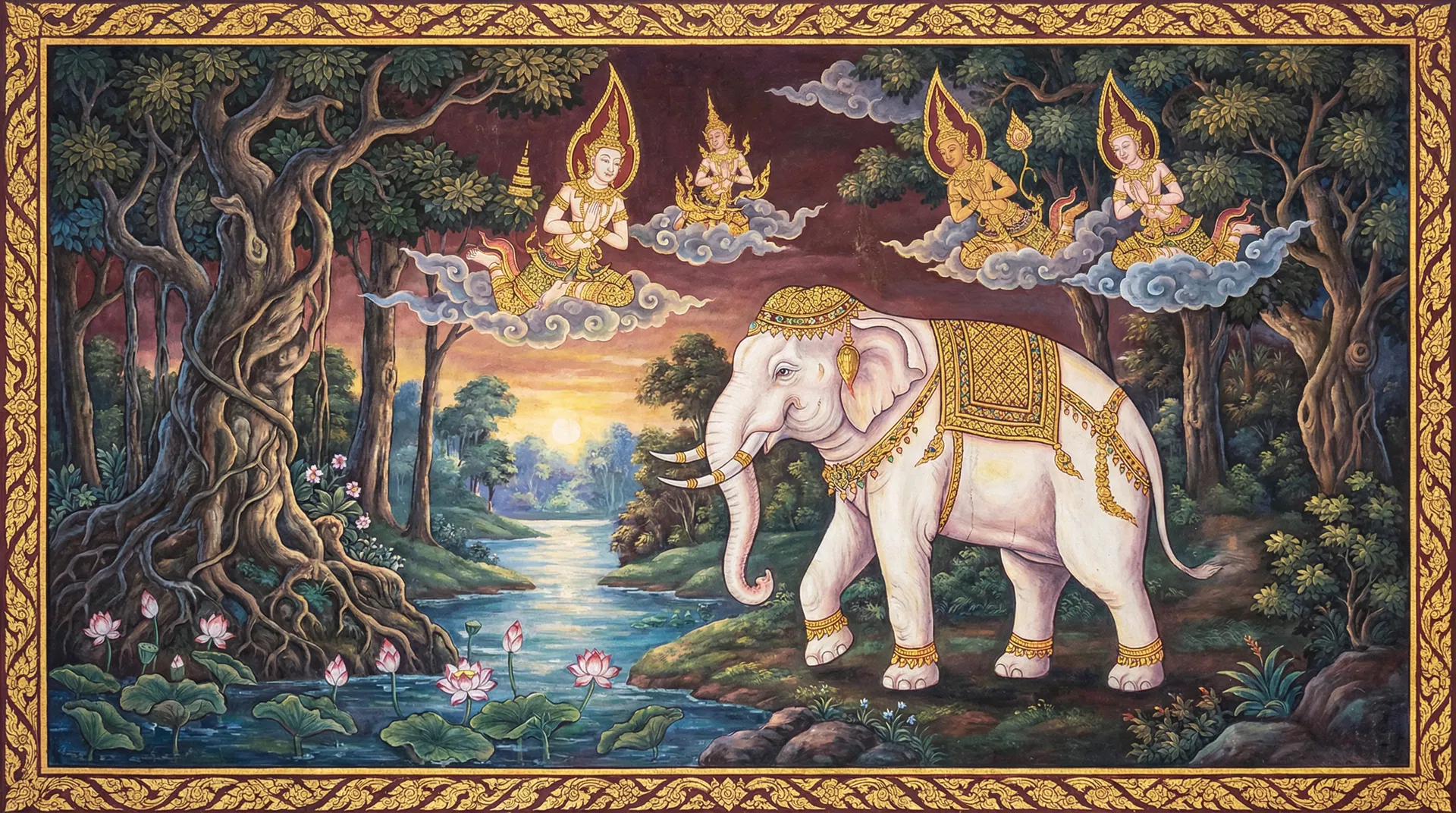
Then, from the neighboring kingdom of Kalinga, came a delegation led by a mendicant, a man who claimed to be able to break the drought with his ascetic practices, but who required a special offering: the white elephant that was a symbol of Jetuttara's prosperity and the King's good fortune. This white elephant, it was said, possessed magical properties that could bring rain.
King Ajita was distraught. He loved the white elephant dearly, and it was an emblem of his kingdom's well-being. He refused the request. However, Prince Vessantara, seeing the suffering of his people and believing in the mendicant's claims, felt a profound urge to help.
He approached his father. "Father," he said, "the people are starving. If giving the elephant can bring rain, then it is our duty to give it. Material possessions are temporary; the well-being of the people is eternal."
King Ajita, though reluctant, saw the unwavering conviction in his son's eyes. He could not deny the depth of Vessantara's compassion. With a heavy heart, he agreed. Prince Vessantara personally led the magnificent white elephant to the mendicant from Kalinga.
As the mendicant took the elephant, a miracle occurred. Dark clouds gathered, and rain began to fall, torrentially at first, then steadily. The land drank deeply, and life began to return to the parched earth. The people rejoiced, praising Prince Vessantara for his selfless act that had saved them from the brink of destruction.
However, the King of Kalinga, upon hearing that his mendicant had received the sacred white elephant of Jetuttara, was enraged. He felt it was an insult to his kingdom. In his fury, he declared war on Jetuttara.
King Ajita was dismayed. He had lost his symbol of prosperity and now faced invasion. Prince Vessantara, however, remained calm. He knew that this was another test of his resolve. He believed that true peace could only be achieved through understanding and self-sacrifice, not through violence.
When the invading army of Kalinga arrived at the gates of Jetuttara, Prince Vessantara did not arm himself for battle. Instead, he walked out alone, dressed in simple robes, and approached the Kalinga king. The Kalinga king, expecting a fierce resistance, was taken aback by the prince's calm demeanor.
Vessantara spoke, his voice gentle yet firm. "Your Majesty," he said, "I understand your anger. You believe I have wronged you by giving the elephant away. But my intention was to save my people from suffering, not to insult your kingdom. True strength lies not in conquest, but in compassion. If my act has caused you pain, I offer myself, my wife, and my children as a tribute. Take us, if that will bring you peace and satisfy your honor."
The Kalinga king was stunned. He had never encountered such profound selflessness. He saw the sincerity in Vessantara's eyes and the unwavering commitment to peace. He realized the futility of his anger and the emptiness of his ambition.
Tears welled up in the Kalinga king's eyes. He confessed his own pride and foolishness. He declared that he no longer wished for war. Instead, he offered his friendship and admiration to Prince Vessantara. He returned the white elephant, acknowledging the wisdom and virtue of Jetuttara's future king.
The story of Prince Vessantara's ultimate act of generosity and peace became legendary. He had given away his kingdom's most prized possession and even offered his family, not out of weakness, but out of an unwavering commitment to the well-being of all beings. He demonstrated that the greatest wisdom is to understand the impermanence of all things and to find liberation through selfless giving, thereby transcending worldly attachments and achieving true peace.
— In-Article Ad —
💡Moral of the Story
True generosity lies in selfless giving, not for recognition or reward, but for the alleviation of suffering and the pursuit of peace. Wisdom is found in understanding the impermanence of possessions and transcending attachment.
Perfection: Generosity (Dana) and Wisdom (Panna)
— Ad Space (728x90) —
More Jataka Tales You May Enjoy
 335Catukkanipāta
Cūḷabodhi Jātaka
Cūḷabodhi JātakaIn the bustling city of Varanasi, where the mighty Ganges flowed and the scent of ja...
💡 True wealth is not measured by possessions, but by the boundless generosity of spirit and the inner peace derived from selfless service to others.
 272Tikanipāta
Dhammapala Jataka
Dhammapala JatakaIn a lush forest, where ancient trees whispered secrets to the wind and a crystal-c...
💡 True happiness is cultivated from within through contentment, mindfulness, and acceptance, rather than being found in the ceaseless pursuit of external pleasures and excitement.
 109Ekanipāta
Sutasoma Jataka
The Tale of the Compassionate Prince and the Hungry Ogress In the grand kingdom of Gandhara, renowne...
💡 True compassion understands and alleviates suffering, even in the face of fear. Selfless kindness can transform even the most hardened hearts.
134EkanipātaSattubhatta Jataka
The Tale of the King Who Sought True Happiness In the ancient and prosperous city of Kasi, ruled a k...
💡 True and lasting happiness is an inner state, cultivated through self-understanding, mindfulness, detachment, and compassion, rather than being dependent on external circumstances or possessions.
97EkanipātaThe Tale of the Ancient Swan
In the city of Savatthi, while the Buddha resided at the Jetavana Monastery, he recounted a past lif...
💡 True nobility resides in the heart and character, not in status or possessions. Forgiveness and inner peace are more valuable than any worldly gain.
87EkanipātaJataka Tale No. 87: The Tale of the Wise Elephant
Jataka Tale No. 87: The Tale of the Wise Elephant In the annals of ancient wisdom, there are ta...
— Multiplex Ad —